Applications
The scanning proton microprobe can be applied across many fields of science, from medical research to micro-electronics, in both academic and industrial environments.
Application Areas
Life Sciences
- •Metal take-up by cells, plants, etc.
- •Trace element distribution in tissues
- •Use of heavy metal traces to map biochemical activity
Materials Science
- •Micromachining
- •Composition of new materials
- •Mapping crystal quality
- •Studies of microelectronic devices
Environmental Science
- •Analysis of individual aerosol particles
- •Analysis of lake, marine and ice sediment particles
- •Pollution history by mapping take-up in shells
Earth Sciences
- •Investigation of meteorites
- •Trace element zoning in rocks
- •Trace elements in microcrystals
- •Surface weathering and diffusion
Archaeological Science
- •Trace element fingerprinting of remains, artefacts and art materials
- •External beam allows studies of large objects
Industrial
- •Diffusion in polymers
- •Contamination in production processes
- •Electrode surface studies
Case Studies
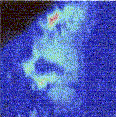
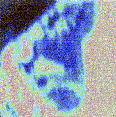
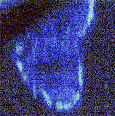
Analysis of Individual Aerosol Particles
Individual aerosol particles from industrial emissions can be characterised using PIXE microanalysis. Elemental maps at a scan size of around 50 microns reveal the composition and structure of individual particles, providing insights into pollution sources and atmospheric chemistry.
Allen Hills Meteorite Analysis
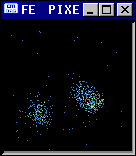
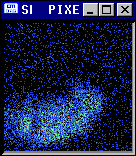
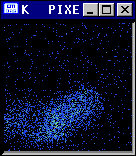
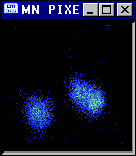
PIXE and RBS maps of the Allen Hills meteorite at 1.75 MeV proton energy, revealing the elemental distribution within the sample. This analysis demonstrates the power of ion beam techniques for geological and planetary science investigations.


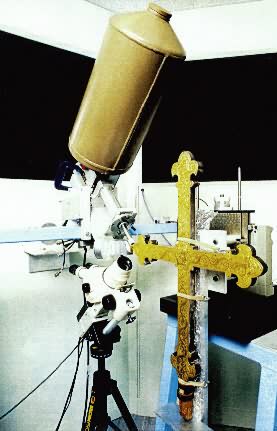
External Beam Analysis of a Gilded Cross
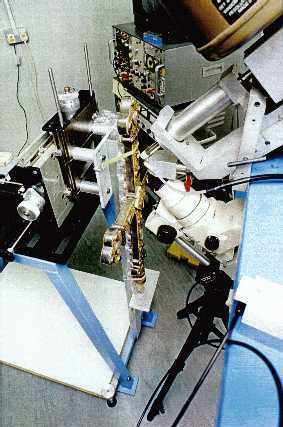
The external beam capability allows non-destructive analysis of large and valuable objects that cannot be placed inside a vacuum chamber. This gilded cross was analysed to determine the composition of the gilding and underlying material, demonstrating the technique for archaeological and art conservation applications.
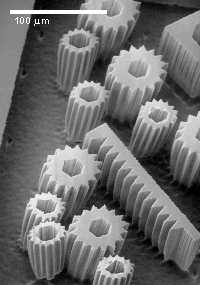
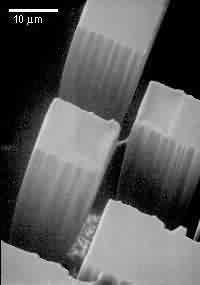
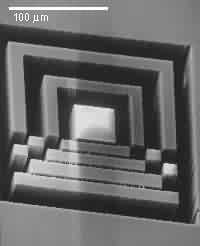
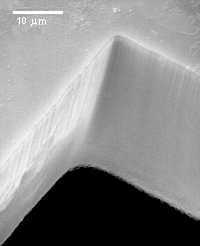
Proton Beam Micromachining
Finely focused, penetrating high energy proton beams can be used to create deep three-dimensional microstructures in lithography resists. These examples from the Centre for Ion Beam Applications (CIBA) at the National University of Singapore demonstrate the precision achievable with proton beam writing.